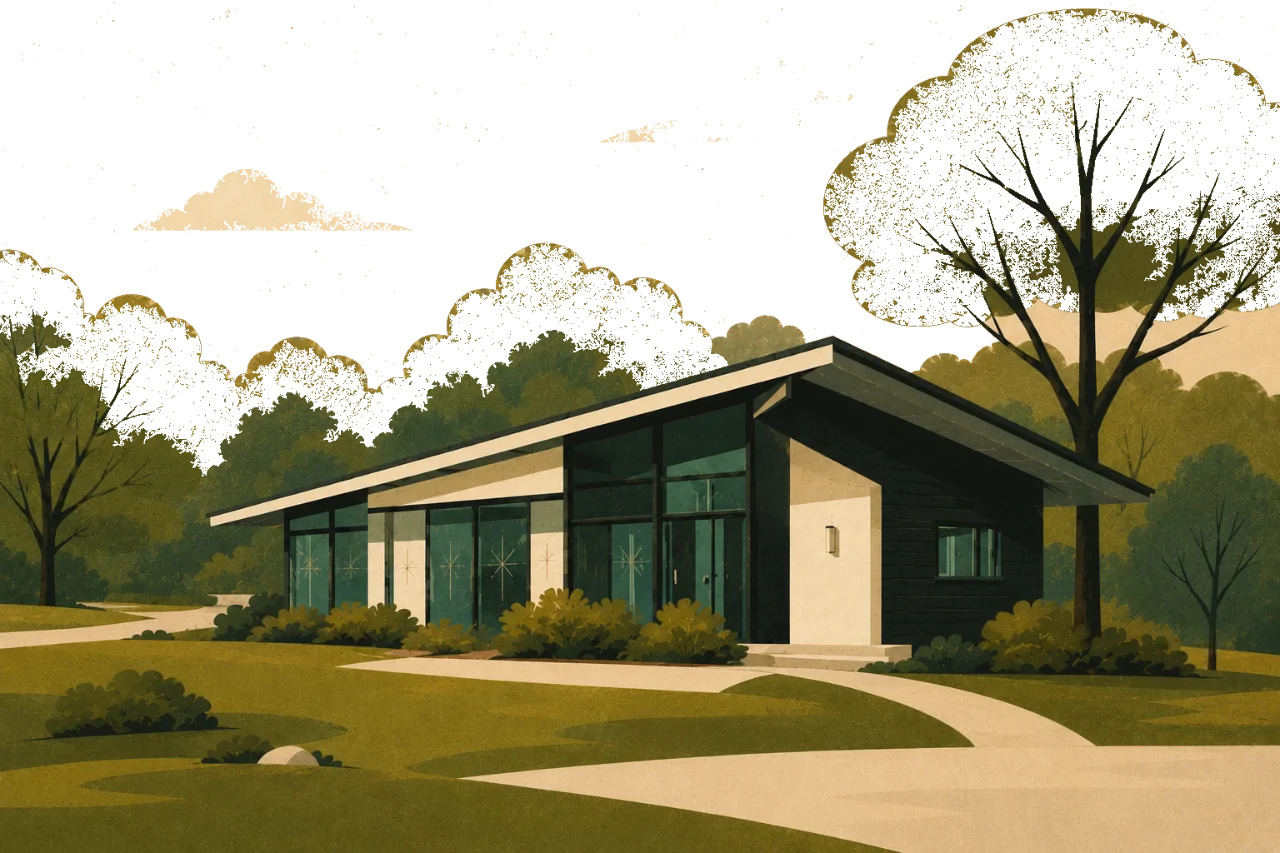
A National Register–listed Charles Goodman neighborhood of 58 homes tucked into 15 acres of wooded, rolling terrain between Kensington and Wheaton — post-and-beam construction, window walls, and one of the most intact examples of postwar modernist community design in the DC area.
Hammond Wood — often written “Hammond Woods,” but officially the Hammond Wood Historic District — is one of the DC area’s most significant mid-century modern neighborhoods, and one of its most misunderstood. It sits not in Bethesda but in the Silver Spring/Wheaton area of Montgomery County (zip 20902), inside the triangle formed by Veirs Mill Road, Connecticut Avenue, and University Boulevard, roughly a mile from both downtown Wheaton and downtown Kensington.
This is not a neighborhood that grew organically with multiple builders. It’s the opposite: 58 Contemporary single-family houses designed by Charles M. Goodman — Washington’s foremost modernist architect of single-family housing in the 1950s — and built between 1949 and 1951 by developer cousins Paul Burman and Paul Hammond. The houses are set into 15 acres of heavily wooded, rolling, deliberately ungraded land, each one sited individually to the topography for privacy and southern light.
The result was considered important enough to be featured in Progressive Architecture magazine in May 1952, and important enough five decades later to be listed on the National Register of Historic Places. The adjacent sister community, Hammond Hill, adds roughly 20 more Goodman homes built by the same team in 1949–50. For buyers who want genuine architect-designed mid-century modern — not “MCM-ish” — at a more attainable entry point than Bethesda’s modernist enclaves, Hammond Wood is one of the best opportunities in the DC market.
Only 58 homes exist, and turnover is limited. Many sales in Goodman neighborhoods happen quickly or quietly — if you’re serious about Hammond Wood, get on my list before something hits the market.
After World War II, Charles Goodman set out to bring true modernism to merchant-built suburban housing — houses ordinary families could buy, designed with the rigor of custom architecture. While his most famous project is Hollin Hills in Fairfax County, Goodman actually did extensive work in Montgomery County, where he was responsible for all or part of seven subdivisions and upwards of 275 single-family homes.
Hammond Wood was among the earliest. Between December 1949 and August 1950, developers Paul Burman and Paul Hammond planned the community on the southwest side of Veirs Mill Road, with Goodman designing the houses and shaping the land plan. Rather than clear-cutting and grading flat lots — the standard postwar practice — the team preserved the existing tree canopy and rolling terrain, exceeding FHA subdivision standards with traffic-calming cul-de-sac planning and tree preservation. Each house was placed individually on its lot (generally 1/6 to 1/4 acre) to maximize privacy and orient the main window walls toward southern exposure and the woods.
Hammond Wood’s location is a quiet superpower. The neighborhood sits about a mile from the Wheaton Metro station (Red Line), making this one of the most Metro-accessible Goodman neighborhoods anywhere. Downtown Wheaton — including Westfield Wheaton mall and one of the region’s best independent restaurant scenes — and downtown Kensington, with its antique row and shops, are each roughly a mile away. Drivers have convenient access to I-495 and I-270 via Veirs Mill Road and Connecticut Avenue.
Green space is everywhere: the Rock Creek stream valley parks and the paved Rock Creek Trail corridor run nearby to the west, and Wheaton Regional Park and Brookside Gardens are a short drive east — fitting for a neighborhood designed around its trees.
Hammond Wood is served by Montgomery County Public Schools. School assignments change periodically; always confirm your specific address with the MCPS boundary lookup before purchasing.
Hammond Wood suits design-first buyers who want a documented, architect-designed MCM home — with the paper trail to prove it — without Bethesda or Hollin Hills pricing; Metro commuters who assumed mid-century modern always means car-dependent (Wheaton’s Red Line station is about a mile away); right-sizers drawn to efficient footprints, walls of glass, and low-maintenance lots under the trees; and preservation-minded renovators who see the long-term value of doing it right.
Buyers comparing Goodman neighborhoods near Kensington usually weigh three: Hammond Wood (1949–51, the National Register–listed flagship), adjacent Hammond Hill (about 20 homes by the same team, 1949–50), and Rock Creek Woods (Goodman’s later 1958–61 subdivision, also National Register–listed). All three trade in the same currency — trees, glass, and design integrity.
National Register listing is primarily honorific — it does not by itself restrict privately funded work — and it can help unlock Maryland’s Homeowner Tax Credit for approved rehabilitation of eligible historic structures. Montgomery County’s local historic designation process is separate; confirm a property’s local status with Montgomery Planning’s Historic Preservation Office before designing an addition.
The market rewards stewardship: in documented Goodman neighborhoods, sensitively renovated homes that respect the original architecture consistently attract the deepest buyer pool. Gut the character, and you’ve bought a small house on a small lot; honor it, and you own a piece of American architectural history.
Fifty-eight homes, one architect, and a National Register listing: Hammond Wood rewards buyers and sellers who work with someone who understands exactly what these houses are. Whether you’re hunting for your first Goodman or preparing to pass yours to its next steward, let’s talk.